

Where the Danube Meets the House of Astor

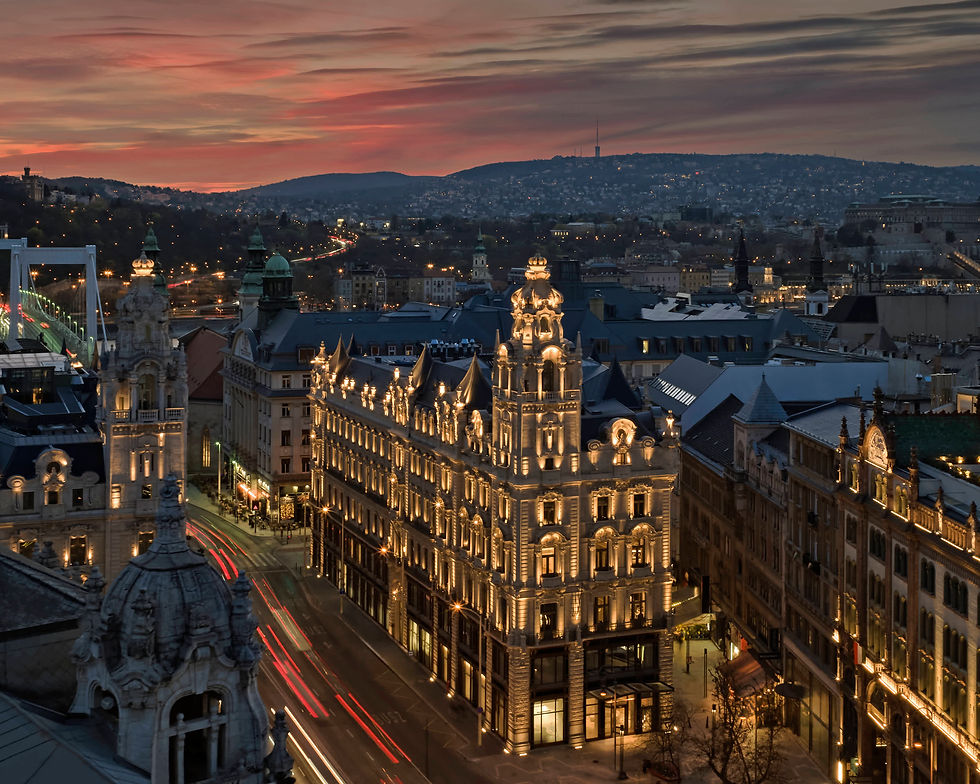
The St. Regis arrives in Budapest's legendary Klotild Palace — and it is, without question, the grandest opening in Europe this year
There are hotel openings, and then there are moments. The debut of The St. Regis Budapest — housed within the breathtaking neo-Baroque Klotild Palace, steps from the Elisabeth Bridge and the silver sweep of the Danube — belongs firmly in the second category. I arrived on a clear morning, the 48-metre tower catching the early light, and felt immediately that Budapest had been waiting for exactly this.
Klotild Palace is not merely a beautiful building. It was commissioned at the turn of the 20th century by Her Imperial and Royal Highness Princess Klotild of Saxe-Coburg and Gotha, designed by the celebrated architects Flóris Korb and Kálmán Giergl, and once served as the ceremonial gateway to Pest for travellers crossing the river. The crown-adorned tower, the UNESCO-listed facades, the sheer sense of occasion that the building imposes upon the street — all of it is absorbed, honoured, and amplified by what St. Regis has created within.
The grand staircase sets the tone from the very first step. Conceived as a vertical river of light, it rises through sculptural ceramics, reflective surfaces and a glass ceiling wreathed in cascading bronze florals and crown-shaped chandeliers. It is not subtle. It is not meant to be. It is a statement of intent — that this is a place where everything, from the architecture to the art of the welcome, has been considered with rigorous, loving care.
The 63 rooms and 39 suites feel like private theatre boxes — a nod to Budapest's deep operatic culture, rooted in the Hungarian State Opera House that has stood since 1884. Framed city views become your personal stage. Brass-accented bedside details, shaded fabrics and decorative tilework echo the city's Art Nouveau tradition without tipping into pastiche. My suite, facing the Danube and the Citadella, rendered the usual question of "do I go out tonight?" entirely beside the point. I stayed in, ordered room service, and watched the river change colour as dusk arrived.
"The interiors carry the Danube's very logic — its fluid movement, its shifting light — rendered in soft blues, shimmering surfaces, and the warm geometry of Hungarian tile."
The Butler
The St. Regis Butler Service is not a novelty here — it is the quiet backbone of the stay. Mine, impeccably discreet, had preferences noted and acted upon before I thought to ask. It is the kind of attentiveness that cannot be scripted.
The St. Regis Bar is a revelation. Designed around a stage-inspired layout, with a sweeping bar counter fronted by a glass mural reimagining the orchestra of the Opera House in full flight, it has the bones of a great bar — one of those rooms that seems to have always existed and merely needed the right stewardship to unlock it. Head Mixologist Norbert Tengely's signature Crown Mary is the drink to order: a considered, beautifully balanced homage to both the palace's royal lineage and the Bloody Mary's storied origins at The St. Regis New York in 1934. His philosophy — "perfection through simplicity and minimalism" — is one I find myself completely convinced by.
The Klotild Patisserie, set within a historic apothecary interior, is the kind of discovery that makes a city feel newly yours. Coffee is a bespoke limited-edition blend; the pastries bridge Hungarian and French-Viennoiserie traditions with quiet mastery. I returned twice.
99 Sushi Bar & Restaurant brings something unexpected and genuinely brilliant to the mix — premium Japanese technique and seasonal precision, delivered through a show kitchen and an omakase experience curated by Group Culinary Director Chef Thinus van der Westhuizen. In the Atrium, Afternoon Tea and the theatrical Champagne Sabrage proceed with full St. Regis ceremony, a brand ritual that feels, in this setting, entirely earned.
The hotel's internal gallery — once a porte-cochere, now a luminous corridor of suspended mirrors and arched ceilings — is the city's most elegant new space for conversation. Budapest's literary café culture finds a natural heir here.
The Spa & Wellness
The St. Regis Spa is an intimate sanctuary that takes Budapest's legendary bathing heritage as its starting point and builds something genuinely contemporary upon it. The indoor pool, traditional hammam, Finnish sauna and experience showers are beautifully considered; the treatment programme, developed in partnership with Sothys and Budapest's own Omorovicza — a luxury skincare house rooted in the city's historic mineral waters — is among the most intelligent spa offerings I have encountered anywhere. The sixth-floor fitness studio, capped with a glass roof that floods the room with natural light, is the rare wellness space where one actively wants to be.


Comments